
What Raises Red Flags — and How to Avoid Them
For many foreign founders, the idea of an IRS audit feels distant. You file what you’re told to file, the business is small, and in some cases there’s little or no U.S. income. That often leads to the assumption that audits are something that only happen to large companies or U.S. residents.
In reality, foreign-owned U.S. LLCs face a different kind of scrutiny. The IRS pays close attention to cross-border structures, information returns, and inconsistencies — even when no tax is owed. In 2026, enforcement around foreign ownership has not softened. If anything, mismatches and missing disclosures are more likely to surface as systems become more automated.
This guide explains how IRS audits actually begin for foreign-owned LLCs, which issues tend to raise red flags, and what founders can do to reduce risk before problems appear. Foreign founders who believe their company has no activity should first understand when a foreign-owned U.S. LLC is considered inactive before assuming there are no federal filing obligations.
Why Foreign-Owned LLCs Attract IRS Attention
An audit is not always triggered by profit. In fact, many IRS reviews involving foreign-owned LLCs start with information reporting, not income.
The IRS treats foreign ownership as higher risk because it involves cross-border money movement, related-party transactions, and assets or owners outside U.S. jurisdiction. When reporting is incomplete or inconsistent, the IRS may assume the full picture has not been disclosed.
Foreign founders are often surprised by this. From their perspective, the business may be small, inactive, or operating mainly outside the U.S. From the IRS’s perspective, a U.S. entity connected to foreign owners automatically falls into a category that requires closer verification.
Form 5472 Errors Are One of the Biggest Triggers
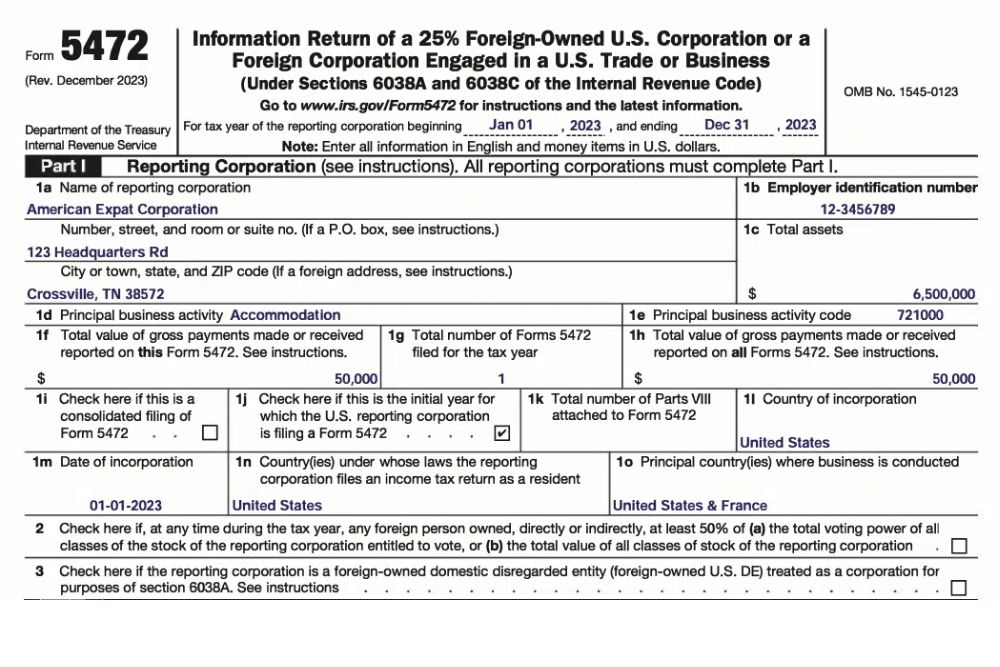
For single-member LLCs owned by non-U.S. persons, Form 5472 remains one of the most common audit entry points.
The form itself is not complicated, but it is highly technical. Even small mistakes can attract attention. The IRS expects the form to accurately reflect reportable transactions between the LLC and its foreign owner or related parties. That includes capital contributions, reimbursements, management fees, loans, or payments for services.
Problems arise when the LLC’s bank activity does not align with what was reported on Form 5472, or when the form is filed with incomplete descriptions or incorrect amounts. In some cases, the form is omitted entirely because the founder believes there was “no activity,” even though money moved through the account.
Because Form 5472 carries automatic penalties, it is often reviewed more aggressively than standard tax returns.
Inconsistencies Between Federal and State Filings
Another common audit trigger is inconsistency across filings.
For example, an LLC may report itself as inactive at the federal level but remain registered and operational in one or more states. Or state filings may show revenue, payroll, or sales activity that does not appear anywhere on federal forms.
The IRS routinely cross-checks data from state agencies, banks, and payment processors. When those sources suggest business activity that is not reflected on federal filings, questions follow.
Foreign founders often underestimate this risk, especially when operating remotely. Even something as simple as maintaining sales tax registration or filing state annual reports can contradict a “no activity” federal position.
If you’re unsure whether your company can pause operations without compliance risks, this guide on can a foreign-owned U.S. LLC stay inactive forever explains the long-term implications clearly.
Repeated Late or Corrected Filings
Late filings happen, especially for founders navigating U.S. compliance for the first time. One late filing does not automatically lead to an audit.
Patterns, however, do.
When the IRS sees repeated late submissions, amended forms, or corrections over multiple years, it may interpret that as a sign of weak internal controls or incomplete reporting. This is particularly true for information returns like Form 5472, Form 3520, or FBAR-related disclosures.
In many cases, audits begin not because of a single error, but because of a history that suggests filings may not be reliable.
Related-Party Transactions Without Clear Documentation
Foreign-owned LLCs frequently transact with their owners or affiliated companies abroad. This is normal — but it must be documented properly.
Payments labeled vaguely as “expenses,” “reimbursements,” or “management fees” can raise questions if there is no written agreement or consistent explanation. The IRS looks closely at whether payments reflect real services or are simply ways to move money across borders.
When transaction descriptions are unclear or inconsistent year to year, the IRS may open a review to understand the nature of those transfers. This does not mean the transaction is illegal — only that it lacks clarity.
Bank and Payment Processor Reporting Mismatches
In 2026, the IRS receives more third-party data than ever before. Banks, payment processors, and platforms report account activity independently of what the LLC files.
Audits often start when reported revenue or inflows appear inconsistent with IRS filings. This can happen even when funds are not taxable income — for example, owner contributions or intercompany transfers.
Foreign founders are particularly vulnerable here because they may assume that non-income transfers do not need explanation. While that may be true for tax purposes, unexplained cash movement can still trigger questions.
Claiming No U.S. Tax Obligation Without Proper Support
Many foreign-owned LLCs correctly conclude that they owe no U.S. income tax. However, stating that position without sufficient documentation can increase audit risk.
The IRS expects clear reasoning behind claims of no effectively connected income, no nexus, or treaty protection. When filings simply state “no tax due” without context, the IRS may seek clarification.
This is especially common when an LLC has U.S. bank accounts, U.S. customers, or U.S. registrations but claims zero U.S. tax exposure.
Since IRS notices are sent to your registered agent, it’s critical to know when to change or cancel a registered agent for a foreign-owned U.S. LLC — and what happens if you don’t update it properly.
How Audits Usually Begin in Practice

Most audits involving foreign-owned LLCs do not start with a full investigation. They begin with a notice.
The IRS may request clarification about a specific form, transaction, or discrepancy. If the response is incomplete or delayed, the inquiry can expand.
This is why many founders feel audits “come out of nowhere.” In reality, the initial trigger may have occurred years earlier, but only surfaces when records are reviewed more closely.
Reducing Audit Risk Without Overcomplicating Compliance
Avoiding audits entirely is not realistic, but reducing risk is.
The most effective approach is consistency. Filings should tell the same story across federal, state, and third-party reporting. Transactions with owners should be documented clearly, even if they are simple. Inactive periods should be supported by clean bank records and timely filings.
Foreign founders who treat compliance as an ongoing process — rather than a once-a-year task — tend to experience fewer issues. Addressing notices promptly and correcting errors proactively also makes a difference.
Most importantly, founders should avoid assumptions. Silence from the IRS does not mean filings are perfect, and low revenue does not eliminate scrutiny.
Final Thoughts
IRS audits of foreign-owned U.S. LLCs are rarely random. They usually follow patterns: missing forms, inconsistent reporting, unclear transactions, or repeated delays.
Understanding these triggers allows founders to stay ahead of problems rather than reacting under pressure. In 2026, the cost of ignoring compliance details is often higher than the cost of getting them right early.
A foreign-owned LLC does not need to be large to be reviewed — it only needs to be unclear.
FAQs
- Does low or zero revenue reduce audit risk for a foreign-owned LLC?
Not necessarily. Many audits are triggered by information reporting issues rather than income. Even inactive LLCs must file correctly and consistently.
- Is Form 5472 a common reason foreign-owned LLCs get reviewed?
Very often, yes. When Form 5472 is missing, filed late, or does not match the LLC’s actual transactions, it tends to draw attention. Many IRS reviews involving foreign-owned LLCs begin with questions about this form.
- Can the IRS raise an issue years after a filing mistake?
It can. Reviews are not always immediate. In some cases, questions arise much later, when older filings are compared against bank records, state data, or newer disclosures.
- Does correcting a mistake increase audit risk?
In most cases, correcting errors proactively reduces risk. Ignoring or delaying corrections is more likely to escalate issues.
